Traditional oversight relies on fragmented snapshots and human-heavy audits, creating structural gaps:
Knowledge dies between cycles: The same issue recurs at the same supplier, for the same reason, because nothing connects past resolutions to future production.
The Remediation Bottleneck: Audits tell you who's failing — but closing the gap with each supplier still takes an expert, in person, one at a time. Past a few dozen suppliers, the math breaks.
Everyone measures, no one remediates: Audits and scores pile up across quality, social and environmental, but closing the gap with the supplier stays 100% manual.

Venso captures your standards and your experts' judgment — quality, social, environmental, written and unwritten — into a living model of what "good" means, tailored to each supplier type, each market, and each requirement.
It then operates directly with every supplier: continuous evaluation, coaching, remediation, and prevention of the same failure recurring — across your entire panel, not one supplier at a time.
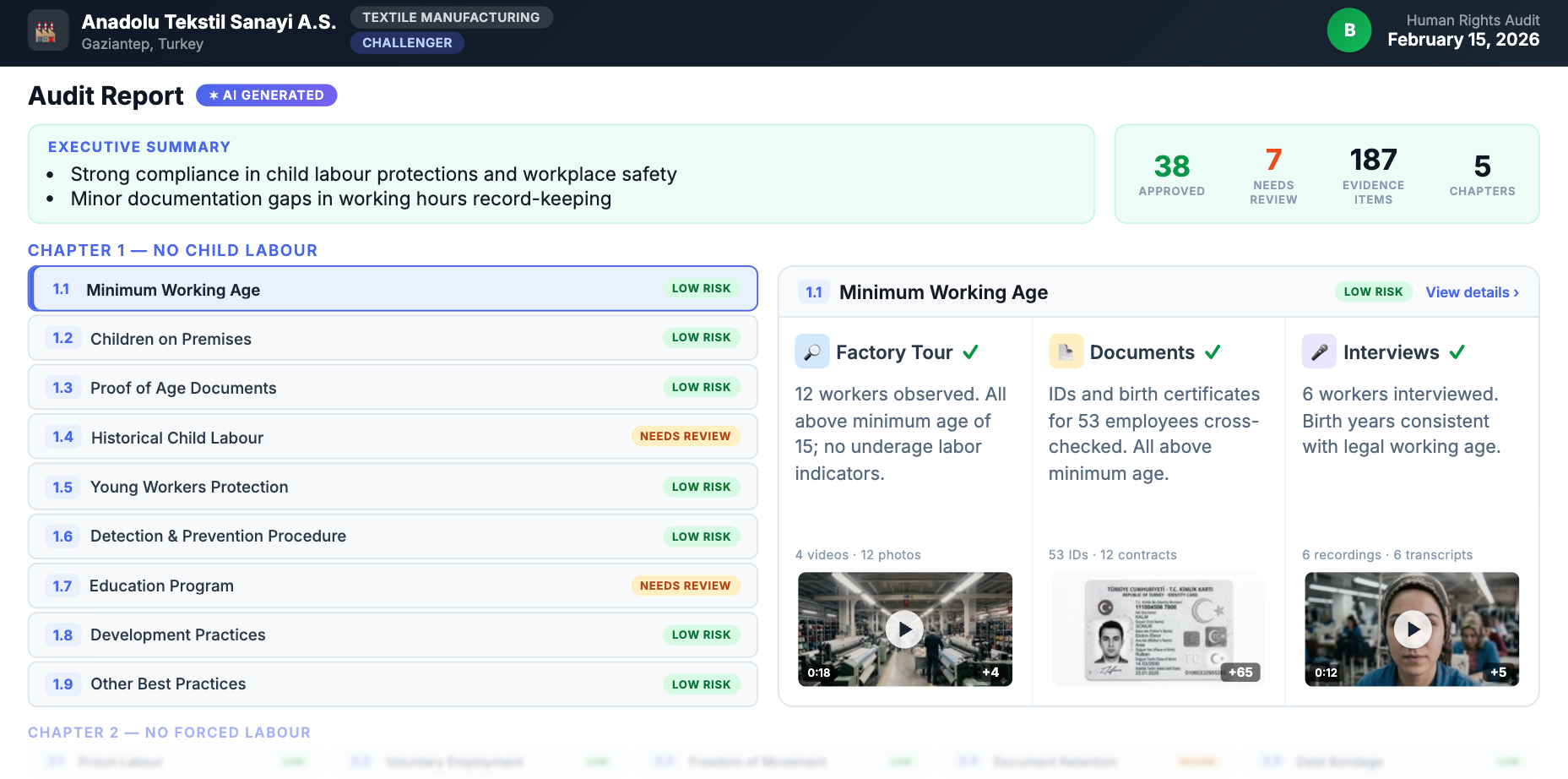

Autonomous AI agents cross-references your standards against ground-truth data, surfacing gaps in real time. Every gap is traced to its root cause, complementing your existing audit program rather than replacing it.

Once a gap is identified, Venso coaches the supplier through the fix (corrective action, verification, sign-off) the way your best expert would, at the scale of your whole panel instead of one supplier at a time.

Every resolved case feeds the model. The same root cause is caught before it recurs elsewhere in the panel, turning each fix into permanent institutional memory instead of a one-off patch.
Your expertise reaches every supplier at once, across all dimensions — not just the bottom 20%.
Past resolutions feed future production, so the same failure stops coming back instead of resetting every cycle.
Reclaim 80% of the time spent chasing corrective actions to focus on high-value network optimization and partnerships.
Your taxonomy, your requirements, your definition of "good" per supplier type — not a one-size-fits-all scorecard.
One place to turn scattered audits into develop / reallocate / exit decisions across quality, social and environmental risk.
Make critical procurement decisions on continuous execution data, not just annual audit snapshots.